Route selectively
Low-risk work stays with the orchestrator; specialist agents are engaged only when technical or adoption signals warrant deeper analysis.
Governed agentic implementation intelligence
A transparent implementation-risk system that combines workflow automation with a governed multi-agent V1, selectively consults specialists, and keeps consequential escalation decisions with people.
The problem
It accumulates across unresolved decisions, customer sentiment, integration dependencies, data readiness, timeline pressure, and unclear ownership. By the time a project is visibly off track, the recovery window may already be narrow.
Beacon explores how AI can help teams synthesize those signals consistently - without hiding the evidence or replacing the leadership judgment that follows.
System design
Structured evidence, selective specialist analysis, and human-controlled action.
A central orchestrator reads the project snapshot and determines whether deeper analysis is warranted.
Technical and adoption specialists are consulted only when the evidence signals their expertise is needed.
The orchestrator returns a typed assessment separating evidence, confirmed risks, missing information, and recommended follow-up.
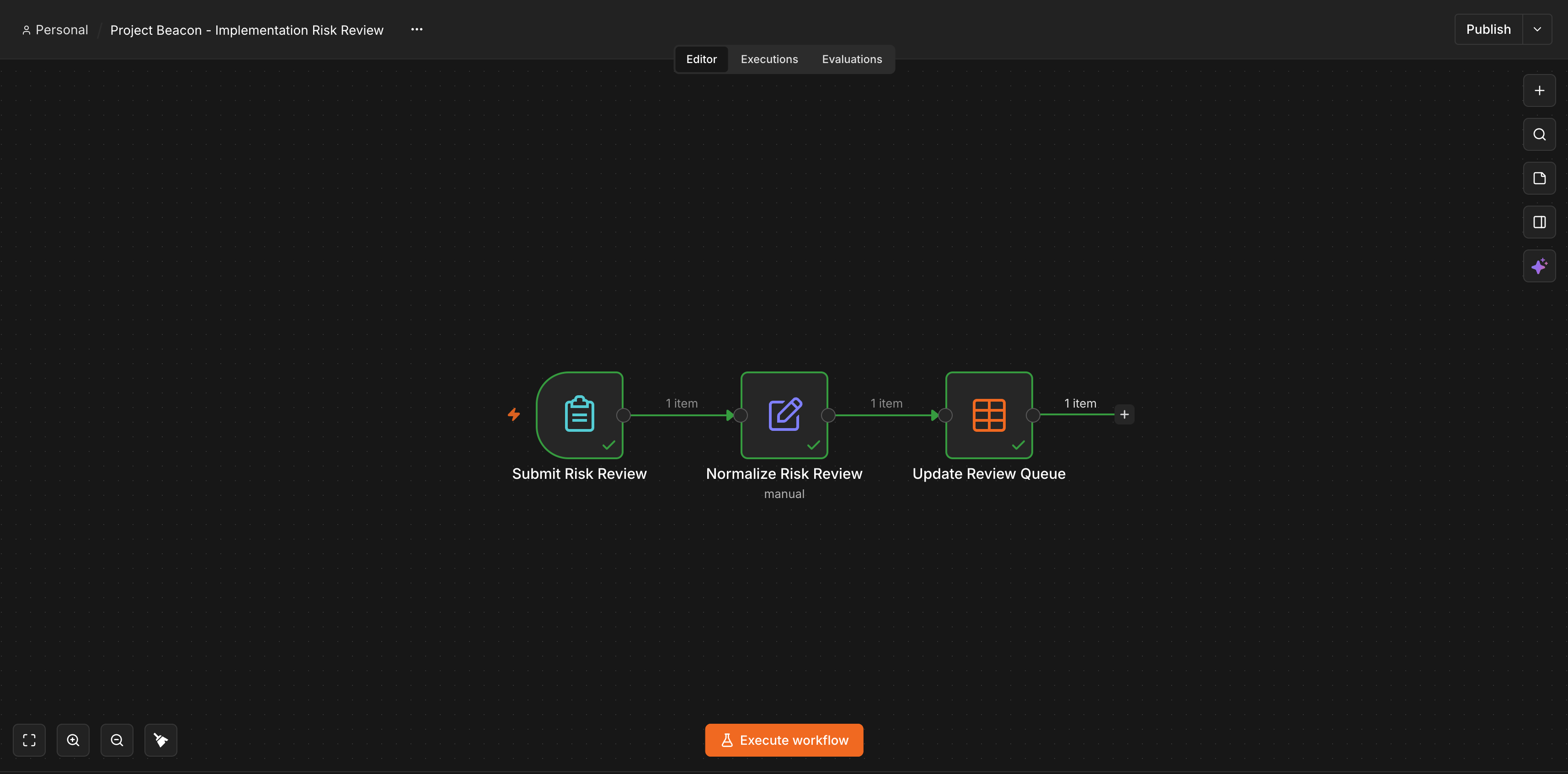
Leadership escalation pauses for explicit human approval; approved and rejected paths remain visible and testable.
Agent-framework extension
I extended Beacon beyond its original n8n risk-triage workflow by building a Python-based multi-agent layer. A central orchestrator can call five evidence tools, consult focused technical or adoption specialists, and produce a consistent structured assessment without granting the system authority to make launch or escalation decisions.
The build includes documented architecture, operating boundaries, a production handoff guide, and a durable approval log that records action only after a reviewer approves it. All demonstration records are fictional.
Working evidence
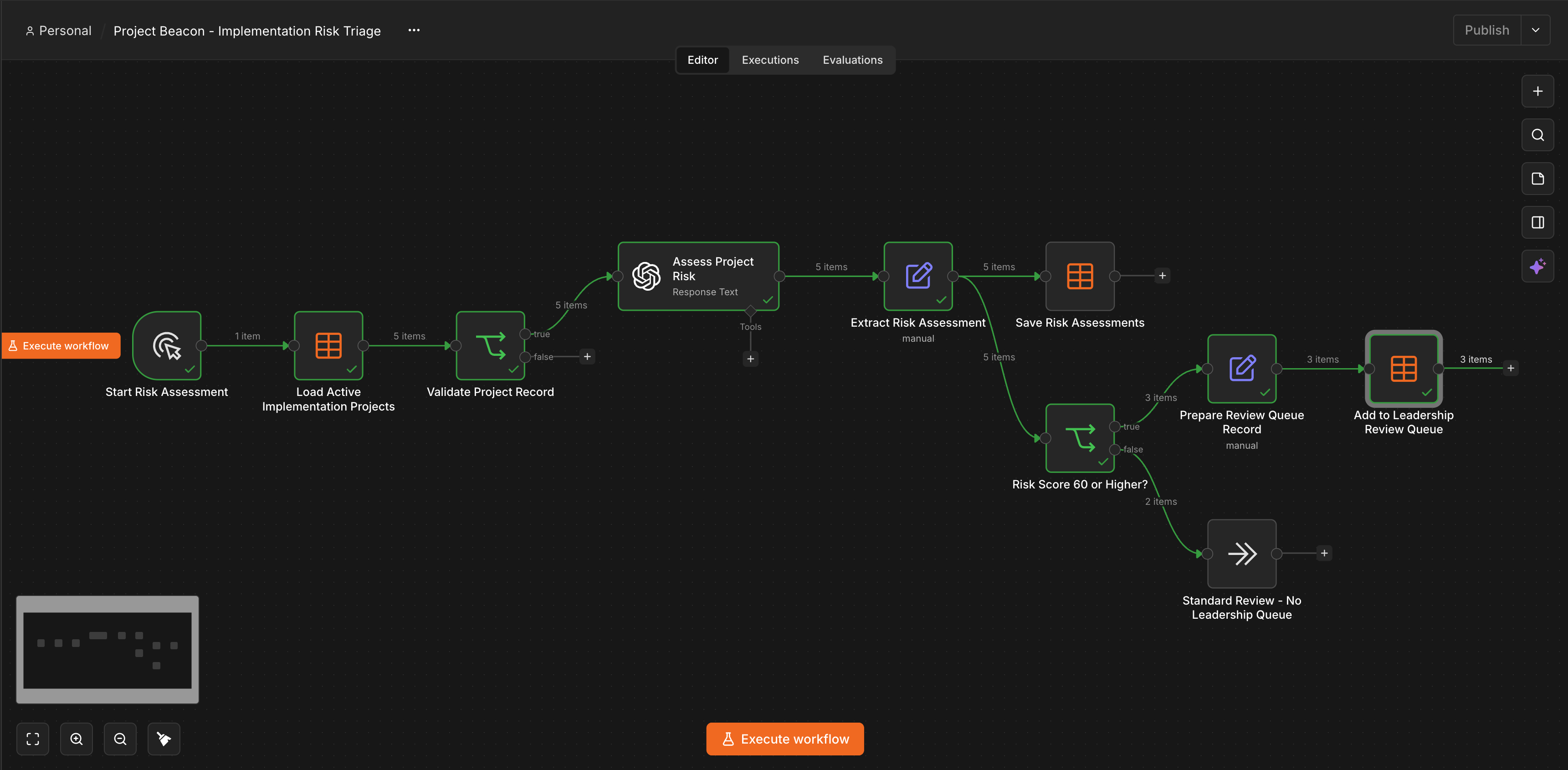
Beacon evaluates representative implementation records, saves the assessment, applies a visible escalation threshold, and creates a leadership review record when the threshold is met.
Validation & governance
Low-risk work stays with the orchestrator; specialist agents are engaged only when technical or adoption signals warrant deeper analysis.
Assessments follow a defined schema so risks, missing information, recommended actions, and escalation status remain inspectable.
Escalation is a governed action: the system pauses for an approve-or-reject decision and records an action only after approval.
Automated tests passed all routing and governance scenarios, including no escalation, approval, and rejection. Risk-label variation remains a documented calibration target.
Current boundary
Beacon demonstrates how agent orchestration, structured evidence, specialist analysis, and human oversight can work together to support implementation-risk decisions. It uses fictional project data and would require production integrations, security controls, observability, privacy review, and broader evaluation before real-world deployment.